Tiny Strings, Big Joy

Chandan Singh
| 15-04-2026
 · Art Team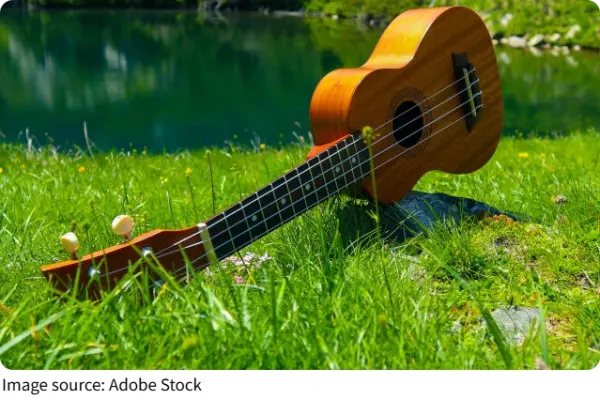
The first time most people see this small, four-stringed instrument, they assume it is a miniature guitar for children.
However, the tiny wooden body carries a sound that has defined entire island cultures and conquered the global music industry multiple times. It is the ultimate "underdog" of the musical world.
Light enough to carry in a backpack yet capable of producing complex, soulful melodies, this instrument is a masterclass in efficiency. It proves that you do not need a massive orchestra or a wall of amplifiers to capture a listener's heart; sometimes, all you need is a bit of wood and the "jumping flea" energy of its unique strings.
The Mystery of the Jumping Flea
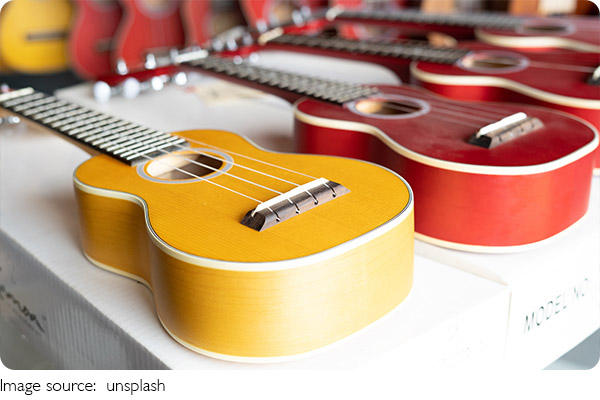
The name of the instrument translates literally to "jumping flea." While there are several theories about why this name was chosen, the most popular involves the visual experience of watching a master play. In the late 19th century, when Portuguese immigrants brought a small four-stringed instrument called the machete to Hawaii, the locals were mesmerized by the speed of the players' fingers.
To the onlookers, the rapid, nimble movement of the musician's hand across the fretboard looked exactly like a flea hopping across a surface. The King of Hawaii at the time, Kalākaua, became a major patron of the instrument, incorporating it into royal ceremonies and ensuring it became a symbol of Hawaiian identity. It was not just a tool for music; it was a bridge between European craftsmanship and Pacific soul.
The Engineering of the Re-entrant Tuning
What gives this instrument its signature "happy" sound is a quirk in its string arrangement called re-entrant tuning. On almost every other stringed instrument, like a guitar or a violin, the strings are tuned in ascending order from lowest pitch to highest pitch.
However, on a standard soprano or concert version of this instrument, the string closest to your face is tuned to a high note. This means the pitch goes high, then drops low, then goes back up again. This "broken" order is why the instrument has such a bright, percussive quality. When you strum, you hit a high note at both the beginning and the end of the motion, creating a shimmering effect that makes even sad songs sound hopeful.
A Global Cultural Phenomenon
Despite its small size, this instrument has dominated global pop culture in distinct waves. From the jazz age of the 1920s to the modern indie-pop era, its portability has made it the go-to choice for wandering songwriters. Here are some surprising facts about its reach:
1. The First Instrument in Space: Due to its light weight and compact size, it was one of the first musical instruments to be brought aboard the International Space Station. 2. Not Actually Hawaiian: As mentioned, its ancestors are the machete and braguinha from Madeira, Portugal. It was adapted and renamed once it reached the Pacific. 3. George Harrison's Obsession: The Beatles legend was a massive fan and used to travel with two in his car trunk at all times, just in case he met someone who wanted to play. 4. Million-Dollar Wood: The finest models are made from Koa wood, which grows only in certain high-altitude regions, making vintage instruments highly collectible assets.
The Ultimate Social Connector
Unlike the piano or the classical guitar, which often require years of solitary practice, this instrument is designed for community. Its low barrier to entry—meaning a beginner can learn three chords and play hundreds of songs in a single afternoon—has led to the rise of massive "Strum-alongs" in cities worldwide. It is an instrument that invites people to sing together, stripping away the intimidation factor of "high art" and replacing it with pure, accessible fun.
The story of the "jumping flea" is a reminder that we should never confuse simplicity with insignificance. In a world that often demands we go "bigger" and "louder," this tiny instrument chooses to be small and bright. It teaches us that some of the most profound expressions of joy are found in the most humble packages. When you hold one, you aren't just holding a piece of wood; you are holding a centuries-old tradition of adaptation and resilience. It reminds us that no matter how complex life gets, there is always room for a simple melody and a bit of lighthearted rhythm to lift the spirit.